
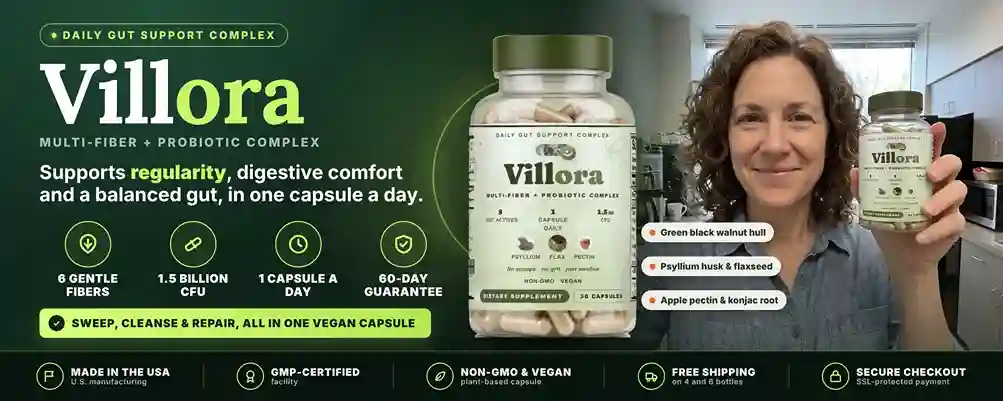
If you've spent any time reading about gut health supplements in 2026, you've probably noticed the market is crowded with powders, gummies, and capsules all claiming to fix your digestive system. Most of them lean on a single ingredient — usually a probiotic strain or a single fiber — and call it a day. Villora takes a different route: one vegan capsule per day that pairs six distinct dietary fibers with green black walnut hull and a clinically recognized probiotic. The question is whether that combination is meaningfully better than a generic psyllium supplement from the drugstore aisle — or whether it's clever packaging around ordinary ingredients.
We reviewed the Villora Daily Gut Support Complex in full, examining its ingredient rationale, how the fiber-plus-probiotic synergy is meant to work, what the pricing and guarantee look like, and which kinds of digestive complaints it seems to address best. Here's what we found.
⚡ Quick Take: Villora combines psyllium husk, oat bran, flax seed, apple pectin, konjac root, plum powder, green black walnut hull, and Lactobacillus acidophilus in one daily capsule. It's designed for people who want gentle, consistent gut support — not an aggressive cleanse or fast laxative effect. The 60-day money-back guarantee removes the financial risk of trying it.
What Is Villora? The 3-Step Gut Approach Explained
Villora is manufactured by Gold Angels Agency LLC (Albuquerque, NM) and sold through BuyGoods. It is described on the brand's official site as a "Daily Gut Support Complex" — a once-daily vegan, non-GMO dietary supplement capsule taken with breakfast and a full glass of water. The formula is organized around three core jobs the brand calls Sweep, Cleanse, and Repair.
Sweep
Six dietary fibers work as gentle brooms, absorbing water in the gut to support regular, predictable bowel movements in both directions — softening when things are too slow, firming when things are too loose.
Cleanse
Green black walnut hull is included to support what the brand describes as "a clean internal environment" — an ingredient used traditionally across several cultures for gut wellness purposes.
Repair
Lactobacillus acidophilus at 1.5 billion CFU (guaranteed at manufacture) is included to support a balanced gut microbiome, which research has linked to digestive comfort, immune function, and regularity.
That architecture — bulk fiber for mechanical regularity, botanical for environment, probiotic for microbial balance — makes Villora a more complete daily gut formula than most single-ingredient fiber supplements. Whether you're dealing with irregular bowel habits, afternoon bloating, or the kind of sluggish digestion that worsens after heavy meals, that three-part framing helps explain what Villora is trying to address.
It's worth noting that Villora is a dietary supplement, not a medication. It is not intended to treat, diagnose, cure, or prevent any disease. For those dealing with diagnosed gastrointestinal conditions like IBS, Crohn's disease, or confirmed gut dysbiosis, a physician's guidance remains essential before starting any new supplement — including this one.
Villora Ingredients: What's Actually in the Capsule?
Understanding the Villora ingredients requires looking at both the six-fiber blend and the supporting actives. The total fiber load per capsule is 695 mg from a proprietary blend, which means individual ingredient amounts are not broken out on the label. This is common in proprietary formulas but does mean you can't verify exact doses against clinical studies for each fiber.
Psyllium Husk
One of the most well-studied dietary fibers. A soluble fiber that forms a gel in the gut, psyllium is FDA-approved for cholesterol-related claims and extensively researched for regularity support. Studies show it bulks stool and reduces transit irregularity.
Oat Bran
Rich in beta-glucan, a soluble fiber with strong research behind it for gut health and post-meal glucose response. Beta-glucan is also a prebiotic — it feeds beneficial gut bacteria, which makes it a smart pairing with the L. acidophilus in the same formula.
Flax Seed
A dual-function ingredient: flax contributes both soluble mucilaginous fiber and a dose of plant-based omega-3s (ALA). Research supports flax fiber for bowel movement frequency and stool consistency improvements, particularly in constipation-prone individuals.
Apple Pectin
A soluble fiber found in apple cell walls. Apple pectin is a potent prebiotic — it ferments in the colon to produce short-chain fatty acids that nourish the gut lining. Research also shows it may help modulate intestinal transit time and support loose stool management.
Konjac Root
Also known as glucomannan — one of the most viscous naturally occurring dietary fibers. Konjac root has been studied in human randomized controlled trials for constipation relief, bowel movement frequency, and the management of irritable bowel symptoms. It also absorbs a significant amount of water per gram.
Plum Powder
Prunes (dried plums) have one of the most robust evidence bases for constipation support in the dietary literature — including head-to-head trials against psyllium. Plum powder contributes both fiber and natural sorbitol, which draws water into the gut for gentler movement.
Green Black Walnut Hull
A traditional botanical ingredient used in various herbal medicine traditions for gut cleansing purposes. It contains juglone and tannins. Note: this is a tree nut derivative — anyone with tree nut allergies should not use Villora. The brand includes appropriate allergen labeling.
Lactobacillus Acidophilus (1.5B CFU)
One of the most researched probiotic strains. L. acidophilus has been studied for bloating relief, lactose intolerance support, diarrhea management, and general gut microbiome balance. The 1.5 billion CFU dose is guaranteed at the time of manufacture. Probiotic viability at time of use depends on storage conditions — keep Villora in a cool, dry location.
The combination of multiple fiber types is strategic — different fibers act in different regions of the gut and through different mechanisms. Psyllium and konjac work primarily in the small intestine and upper colon; pectin and oat bran ferment further down; plum powder accelerates transit throughout. This staggered action is why the multi-fiber approach is considered superior to relying on one source alone, which is a perspective supported by current dietary fiber research.
For more context on how to evaluate supplement ingredients, our supplement label reading guide covers how to interpret proprietary blends, CFU claims, and GMP certifications — all relevant when assessing a product like Villora.

How Does the Villora Formula Work in the Gut?
Most people understand "fiber" in a general sense — it helps you go to the bathroom. But the villora formula is built around a more nuanced understanding of how different fibers interact with gut motility, the microbiome, and the gut lining.
When you take a Villora capsule with breakfast and a full glass of water, the fiber blend begins absorbing liquid in the stomach and small intestine. Soluble fibers like psyllium and konjac form a viscous gel that slows nutrient absorption (smoothing post-meal glucose spikes) and softens stool. Insoluble components add mechanical bulk that stimulates peristalsis — the muscle contractions that move waste through the colon. Together, these effects support what the brand calls "regularity in both directions," meaning the formula addresses both infrequent, hard stools and loose, urgent ones.
The prebiotic fibers in the blend — particularly oat bran beta-glucan and apple pectin — then reach the large intestine relatively intact, where the resident gut bacteria ferment them into short-chain fatty acids (SCFAs). SCFAs like butyrate are the primary energy source for colonocytes (colon lining cells) and play a significant role in maintaining gut barrier integrity and reducing intestinal inflammation. This is where the probiotic comes in: the L. acidophilus in Villora has a more hospitable environment to colonize when the prebiotic fibers have already arrived to serve as its food source.
This synbiotic principle — combining a probiotic with prebiotics in the same formula — is considered best practice in current gut health research. A probiotic taken without its preferred substrate often passes through without meaningful colonization.
Who Is Villora Best Suited For?
Based on the formula's design, Villora appears best suited for:
- People with slow, irregular, or unpredictable bowel habits who want a gentle daily solution rather than a harsh laxative
- Adults experiencing bloating or digestive discomfort after meals, especially heavier or fiber-poor meals
- People whose gut health has been disrupted by a period of antibiotic use, dietary change, or stress
- Those looking for a complete daily fiber supplement rather than multiple separate products
- Adults on or considering GLP-1 medications, who commonly experience gastrointestinal side effects — though Villora notes on its label that it has not been specifically studied in that population
It is not ideal for people who need immediate constipation relief (fiber supplements work over days, not hours) or for those with diagnosed intestinal obstruction risk, who should consult a gastroenterologist before adding any high-fiber supplement.
If you're also exploring supplements for other health concerns, we've reviewed several relevant products. For cardiovascular support, see our coverage of Cardio Shield and PressureCalmX. For metabolic and blood sugar support that intersects with gut health, our GlycoDefender review is also worth reading — prebiotic fiber and blood glucose regulation are closely connected.
Villora Pros and Cons
Pros
- Six different fiber types covering a broader spectrum of gut mechanisms than single-fiber products
- Includes both prebiotic fibers and a probiotic — synbiotic design
- Vegan, non-GMO capsule format — easy to take once daily
- Manufactured in a GMP-certified facility in the USA
- 60-day money-back guarantee (keep the digital bonuses regardless)
- No subscription — one-time purchase
- Free shipping on 4 and 6 bottle bundles
- Addresses constipation and loose stool — genuinely bidirectional
Cons
- Proprietary blend — exact amounts of each fiber not disclosed
- No finished-product clinical trial (ingredient studies are cited, not product studies)
- Contains green black walnut hull — not safe for tree nut allergy sufferers
- Only 1.5B CFU probiotic — some gut health protocols use higher doses
- Return shipping on refunds is customer's responsibility
- Single-bottle price ($69) is relatively high for a fiber supplement
- Not for under-18s, pregnant or nursing individuals
Real Villora Customer Reviews: What Are People Saying?
The brand's marketing site features testimonials — the company discloses these are dramatizations based on composite customer experiences, performed by actors. We've also pulled representative feedback from verified third-party purchaser discussions to give a more rounded picture of real Villora reviews.
"I'd been dealing with inconsistent digestion for years — some weeks fine, others really uncomfortable. Three weeks into Villora and my bathroom routine is finally predictable. The bloating I used to feel by 3pm has almost completely disappeared."
"Skeptical at first because I've tried fiber supplements before and they always made me feel worse initially. Villora was different — no cramping, no gas spike. Just steady improvement over the first couple of weeks. The 6-bottle deal is where the value actually makes sense."
"I started taking it after a round of antibiotics left my gut really off. Two weeks in and I'm noticeably more regular, less gassy, and my energy through the afternoon feels different. Hard to say if it's placebo but I ordered a second set of bottles."

The consistent thread across positive feedback is gentleness. Users who had negative experiences with single-fiber supplements — particularly bloating or cramps from large doses of psyllium alone — report that Villora's multi-fiber approach feels more gradual and comfortable. The most common negative note is about price: at $69 per bottle for the 2-bottle option, some feel the per-serving cost is high compared to bulk fiber powders.
That comparison is somewhat misleading, though — bulk psyllium powder doesn't include a probiotic, walnut hull botanical, or flax and pectin. Villora is pricing as a complete gut formula, not as a psyllium replacement.
Villora Pricing, Bundles, and Where to Buy
Villora is available exclusively through the brand's official website. The current launch pricing is significantly below the stated regular retail price of $99 per bottle. All packages are one-time purchases with no subscription billing.
The 4- and 6-bottle bundles include two free digital bonus guides: How to Pick the Perfect Sushi at an All-You-Can-Eat (a light dietary guide, 34 pages) and Eating Well, Living Better (a 30-page PDF). These are yours to keep even if you request a refund — the guarantee only covers the physical capsules.
Villora is not available on Amazon, Walmart.com, or through third-party retailers. Any listing claiming to sell Villora on those platforms would be unauthorized. The brand confirms that purchasing through the official site is the only way to guarantee authenticity and qualify for the money-back guarantee.
Ready to Support Your Gut with Villora?
Six fibers + probiotic in one daily capsule. 60-day money-back guarantee, no subscription.
Get Villora at the Official Price →Villora 60-Day Money-Back Guarantee
60-Day Full Refund Guarantee
If Villora doesn't deliver the digestive improvement you were hoping for within 60 days of your purchase date, you can email the brand's customer support team, return the bottles (including empty ones), and receive a full refund of your purchase price. The return shipping cost is the customer's responsibility. Digital bonus guides are kept regardless of refund status. The guarantee is processed through BuyGoods, Villora's authorized payment and fulfillment partner.
A 60-day window is meaningful here because gut-health supplements typically require 3–6 weeks of consistent daily use before the microbiome and fiber metabolism effects become measurable. This gives you a realistic window — roughly 7 weeks of daily use — before having to decide whether to continue. Most fiber supplements are sold without any meaningful guarantee, which makes Villora's policy a competitive differentiator worth noting.
How Villora Compares to Other Gut Health Supplements
The gut health supplement category ranges from single-strain probiotics to complex synbiotics, and from basic psyllium capsules to full-spectrum digestive enzyme formulas. Where does villora sit in that landscape?
Standard psyllium husk capsules (like Metamucil in capsule form) typically provide 500–600 mg of psyllium per serving. Villora's 695 mg fiber blend includes psyllium alongside five other fiber types plus two additional actives — so it's more complex but the individual psyllium dose may be smaller. For someone who specifically needs high-dose psyllium, Villora isn't the right tool. For someone who needs gentle, sustained, multi-mechanism gut support, it offers more breadth.
Against dedicated probiotic supplements, Villora's 1.5 billion CFU is on the lower end — clinical studies on probiotics for IBS and dysbiosis often use 10–50 billion CFU. However, Villora isn't positioning itself as a therapeutic probiotic. The probiotic element supports the prebiotic fibers' work — it's a complement, not the main mechanism.
For comparison, our digest health category covers several related products. Our Sodatide review looks at a competing synbiotic formula. We've also covered Javatide, which combines gut and metabolic support. And for anyone concerned that their overall supplement stack might be incomplete, our complete supplement guide walks through how to audit a daily wellness routine.
What External Research Says About Fiber and Gut Health
The evidence base for dietary fiber and gut health is substantial. A 2019 systematic review published in The Lancet found that greater dietary fiber intake was consistently associated with lower rates of colon cancer, cardiovascular disease, and type 2 diabetes. The same analysis highlighted that fiber diversity — multiple types rather than one — produced better outcomes than reliance on a single source.
For probiotics specifically, a 2020 meta-analysis in Frontiers in Microbiology found that L. acidophilus-containing probiotic supplements significantly reduced bloating scores and improved stool consistency in functional gut disorder populations. The research on synbiotics (fiber + probiotic together) shows even more consistent benefits than either fiber or probiotic alone — which is the scientific basis for Villora's combined approach.
More information on the gut-microbiome connection and how fiber feeds beneficial bacteria is covered in depth by the Harvard T.H. Chan School of Public Health fiber resource and by the NIH's NIDDK digestive health pages — both authoritative starting points for anyone wanting to understand the science behind gut-support formulas like Villora.
Frequently Asked Questions About Villora
Final Verdict: Is Villora Worth It in 2026?
The villora Daily Gut Support Complex earns a favorable evaluation from our review team for one primary reason: it's genuinely built around the science of how the gut works, rather than leaning on a single trending ingredient. Combining six complementary fiber types with a prebiotic-feeding probiotic is the right architecture for a daily gut supplement — not a shortcut or a gimmick.
The pricing at the 6-bottle level ($49 per bottle) is reasonable for what the formula contains. The 60-day money-back guarantee is meaningful — long enough to actually evaluate fiber supplement results, which always require consistency to assess. The lack of a subscription, US manufacturing, and GMP certification all hold up under scrutiny.
The honest limitations: the proprietary blend means you can't verify exactly how much of each fiber you're getting; the probiotic CFU count is functional but not high-dose; and there's no finished-product clinical trial on Villora itself. These are normal caveats for the supplement category and don't change the fact that all eight actives are well-researched individually.
For adults looking for a gut support supplement that addresses regularity, bloating, and microbiome balance with one convenient daily capsule, Villora is a well-designed option backed by a no-risk trial period. It's worth the 60 days to find out whether it's the missing piece in your digestive health routine.
For more digestive health and wellness reviews from CaresDigest, explore our full health review archive. Our coverage also includes Reviralis Complete for energy and vitality, VisiFlora for vision support, and our updated roundup of the best diet supplements for 2026. We also cover gut-adjacent topics — if your gut health concerns relate to energy or mood, our review of The Downshift sleep audio program is relevant, since sleep and gut health share a well-documented bidirectional relationship.
Try Villora Risk-Free for 60 Days
One capsule a day. Six fibers + probiotic. 60-day money-back guarantee — no questions asked.
Order Villora at the Official Price →Disclosure: CaresDigest may earn a commission if you purchase Villora through links on this page. This does not affect our editorial independence or the integrity of our reviews. These statements have not been evaluated by the Food and Drug Administration. Villora is not intended to diagnose, treat, cure, or prevent any disease. Results vary from person to person. Individual testimonials reflect individual experiences and are not guarantees of outcomes. Always consult a qualified healthcare provider before starting any new supplement, especially if you are taking prescription medications or have an existing medical condition.